Community Partnerships Support Wildlife Conservation and Hands-on Education
Jefferson County Parks, in partnership with local volunteers, educators, and utilities staff, has completed the installation of a new osprey nesting platform at Dorothy Carnes Park East, marking yet another milestone in ongoing efforts to support native bird populations and enhance wildlife habitat within the park.
The installation fulfills a long-standing goal of the Friends of Rose Lake, which has advocated for a dedicated osprey nesting structure since 2019. That year, an active osprey nest had to be removed from an ATC transmission pole within the park for safety reasons, leaving the area without a suitable nesting site. Since then, Friends of Rose Lake members have worked diligently with park staff to raise funds and advance a solution that would safely accommodate returning ospreys.
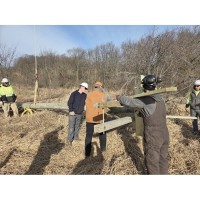
Jefferson County Parks Operations Supervisor Rolland “JR” Klement led the project on behalf of the Jefferson County Parks, coordinating fundraising, design, and installation with numerous partners. Students from Fort Atkinson High School provided a key educational component under the guidance of ecology teacher Stephanie Schreiner. Students in her ecology class assisted with assembling the nesting structure, gaining hands-on experience in conservation, ecology, and community service.
On February 24, crews from Jefferson Utilities came on site to drill and set the pole that now supports the osprey platform. Jefferson Utilities also donated the pole and assembly hardware for the structure. The successful installation reflects a true team effort involving county staff, students, utility professionals, Friends of Rose Lake volunteers, and other community supporters.
Nesting platforms have played a critical role in the long-term return of ospreys and bald eagles to southern Wisconsin. Once nearly eliminated from the region due to habitat loss, pesticide use, and human disturbance, these raptors have rebounded in recent decades thanks to conservation efforts, cleaner waterways, and the availability of safe nesting structures. Purpose-built platforms reduce conflicts with infrastructure, increase nesting success, and help anchor breeding pairs to suitable habitats near lakes and wetlands.